
Digital technologies and AI are reshaping every sector of the global economy, compressing decades of change into years, if not months. For Africa, this technological tsunami presents both an opportunity and a risk. The continent’s structural advantages are considerable: minimal legacy infrastructure, a fast-growing population that is the world's youngest, and widespread consumer adoption. With these advantages, digital public infrastructure and AI have the potential to transform agriculture, health care, education, financial services, and public administration by expanding access, improving productivity, and enabling better outcomes at a scale previously unattainable.
But while growth in AI is projected to add $15.7 trillion to global GDP by 2030, Africa’s digital economy is growing slowly enough to be concerning. It accounts for only 5% of the continent’s GDP, versus a global average of 15%. At its current trajectory, it will have reached just 8.5% by 2050.
Africa’s challenge is not simply to accelerate digital adoption, but also to ensure that entities on the continent increasingly build, govern, and own the infrastructure, data, capabilities, and innovation ecosystems that underpin AI. It’s not enough for countries to consume more digital and AI technology. Winning means producing them: capturing value from the technology stack itself.
The Risks of Falling Behind
Certainly, Africa has made tangible technological progress. It has the fastest-growing cloud market in the world, and consumer adoption of digital confirms that demand exists. Mobile connectivity alone boosted GDP in Africa more than in any other developing region. Mobile money has been a major success; for example, Kenya’s M-Pesa currently serves 60 million customers in eight African markets. But digital infrastructure remains underdeveloped, and the foundations for AI-enablement are weak. Although Africa accounts for 18% of the world’s population, it possesses less than 1% of global data center capacity, and large language models (LLMs) support less than 2% of the continent’s roughly 2,000 languages.
The economic implications for Africa are sobering, especially as development pathways that have fueled growth in other emerging economies—notably business-process outsourcing, call centers, and labor-intensive manufacturing—become less available as agentic AI and robotics transform these industries. Without a foothold in tech production, Africa risks repeating a familiar historical pattern, except that instead of minerals or agricultural outputs, data becomes the new raw material. In that scenario, everything from usage data and satellite imagery to behavioral and clinical data sets feeds proprietary models built abroad, with outputs returning home under license.
Three Structural Constraints Explain the Gap
Africa's digital underperformance is not inevitable. It reflects three shortcomings that cause value to flow out:
- Fragmentation. Individually, Africa's 54 economies are too small (not one exceeds $500 billion in GDP) to justify the infrastructure investment that a modern digital economy needs. Within countries, individual organizations have limited investment capacity. At both levels, fragmentation hamstrings scale.
- Brain Drain. Tech talent is scarce. The continent’s 62,000 AI specialists (including, engineers, data scientists, and product managers) account for only around 5% of the global AI workforce. Many software developers work remotely for foreign companies (a 2021 report put the figure at 38% of Africa’s AI specialists).
2 2 The report, from Google and Accenture, is Africa Developer Ecosystem 2021. Africa’s pool of developers is the fastest-growing in the world, but it risks being scooped up by global demand before local ecosystems can draw on it. - Reliance on Imported Systems. Together, costly licensing and vendor lock-in restrict flexibility, delay innovation, and concentrate value externally. Closed architectures limit ecosystem participation, reduce the incentives for skilled local talent to stay where they are, and discourage local firms from developing and innovating. African companies pay up to 35% more than their peers elsewhere for the same software and equipment. (See Exhibit 1.)

Three Priorities to Advance Africa’s Digital and AI Development
Africa’s challenge is not unique. A decade ago, several developing economies faced similar limitations. Yet they succeeded in establishing digital foundations that have enabled them to deliver tangible value at scale.
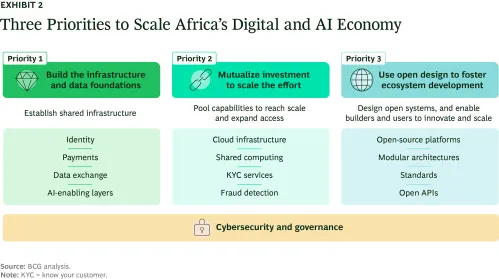
Three areas stand out as essential for advancing the continent’s digital and AI prospects: building the infrastructure and data foundations; mutualizing investment to scale the effort; and pursuing an open-source approach to ecosystem development. (See Exhibit 2.) Each of these areas requires a firm underpinning of trust, security, and governance mechanisms.
Priority 1: Build the Infrastructure and Data Foundations
Many African countries attempt to build, operate, and maintain a complex digital infrastructure without having first developed the necessary depth of technical expertise or resources. Integration costs are high, and ongoing maintenance is demanding, so it’s little wonder that many such initiatives stall.
Another major pitfall is the lack of clear data governance. Without data classification policies in place, data access tends to default to maximum restriction, which limits system usability and constrains economic potential.
A third, often overlooked obstacle is the lack of investment-readiness. Incomplete feasibility studies, weak legal structures, and insufficiently documented economic models make otherwise viable projects untouchable to potential financing entities.
Public-private partnerships (PPPs) are the only practical way to build core digital infrastructure. Identity should serve as the base layer, with payments and data exchange platforms built on top. Building infrastructure foundations across multiple high-impact sectors ensure a robust, expandable system and encourage investment (both financial and attitudinal) and widespread participation among the largest possible pool of stakeholders.
India’s Aadhaar system offers a compelling example of effective foundation building. In 2009, more than 400 million Indian citizens lacked formal identity, which prevented them from accessing financial services. The country built Aadhaar, its digital identity rail, with an interoperable infrastructure. The Unique Identification Authority of India, a government entity, set the mandate and retained ownership, while private technology firms developed the biometric enrollment infrastructure. Legal codification of data governance rules occurred early on. Tokenization ensures that banks, employers, and service providers can confirm users’ identity without accessing underlying personal data. Within six years, Aadhaar had enrolled 1.4 billion people, reduced identity verification costs from around $12 to $0.06 per transaction, and drove financial inclusion above 80%, accomplishing all of this for less than $1 per unique identification issued.
More recently, in Africa, Rwanda developed its IremboGov platform, which offers an alternative to government-led or donor-funded open-source models. Instead, a private operator handles delivery of the national service under a long-term concession deal.
IremboGov is a digital gateway through which the country’s citizens can access more than 100 public services, from business registration and land transactions to health and education. The government retains ownership, strategic control, and policy authority, while Irembo, a private Rwandan company, carries the commercial risks and earns revenue tied to actual service delivery. Open APIs and a single sign-on allow other institutions and developers to build on top of the system.
Since its inception in 2015, IremboGov has processed more than 51 million transactions, and it now features more than 7,000 service providers.
Advancing the Agenda
A well-functioning digital infrastructure requires private execution with public ownership and oversight, along with sound data governance. Strong data governance mechanisms promote responsible use and help avoid restrictions that limit adoption, thereby stimulating further expansion of the digital infrastructure.
Here are three powerful strategies for developing infrastructure:
- Partner to build. Just as they do with physical infrastructure, governments and the private sector can work together to develop and operate digital infrastructure. PPP structures can take various forms, including build-operate-transfer models, concessions, and joint ventures.
- Establish robust data governance early on. Key aspects of governance include classifying data by sensitivity and defining clear rules of use for each class, such as where data can be stored and whether and when AI or LLM processing is permissible. For some systems, such as identity platforms, the state should retain possession of core data. Governance also entails delineating unambiguous ownership and access rights from the outset.
- Prioritize use cases. Investing first in applications where latent demand is highest—such as digital ID, electronic know-your-customer (KYC), instant payments, and social transfers—will spur adoption. The larger the user base is, the faster and more extensively people will use the system. This, in turn, will create the traction needed to justify and finance broader platform development.
The magnitude of the economic and social impact achievable from data ownership and governance can be quite impressive. (See the sidebar, “Filling the Agriculture Data Gap with a Promising Digitally Enabled Innovation.”)
Filling the Agriculture Data Gap with a Promising Digitally Enabled Innovation
Priority 2: Mutualize Investment to Scale the Effort
Building infrastructure as a single player, whether a company or a country, is rarely viable in African markets. Without sufficient demand aggregation, it will be difficult for investments to reach sustainability. Mutualization—pooling investment at the national, regional, or sectoral level—can be an answer.
Core capabilities, such as cloud services, registries, KYC processes, and fraud detection, require significant upfront investment. But once built, they are reusable across institutions and sectors at decreasing marginal cost. The scale effects of AI only amplify the impact.
Consider India's UPI, the shared payment rail. In 2016, NPCI, a nonprofit owned by India's major banks and supervised by the Reserve Bank of India, built and received authority to operate UPI. The government both mandated and incentivized participation to drive adoption, setting transaction fees to zero for merchants and introducing incentive schemes for low-value payments. The user base grew quickly, which reduced unit costs. This justified additional government subsidies, which in turn accelerated further adoption. Today, the network includes more than 700 banks and 40 third-party providers (including PhonePe, Google Pay, and Paytm), each competing on services while cooperating on the common backbone. UPI is now the world's largest real-time payment system, accounting for around 49% of global transaction volume.
Advancing the Agenda
Defining and actively encouraging mutualization mechanisms at both the country level and the industry level can significantly improve the economics of digital investment in Africa.
Two actions are especially important in fostering mutualization:
- Create fiscal and regulatory incentives and collaborative frameworks. These types of mechanisms encourage shared infrastructure, enforce interoperability standards, and facilitate cross-border coordination. Implementation can occur at the pan-African level or at the regional level, such as via the Economic Community of West African States, the Common Market for Eastern and Southern Africa, or the African Continental Free Trade Area Protocol on Digital Trade and Its Annexes. The last of these already offers a promising foundation in the form of a proposed protocol—the Continental Interoperable Regulatory Framework and Rules of Origin—that requires at least 51% African ownership for preferential market access.
- Share the costs. Thus far, private capital alone has not built any mature digital economy. Once PPP agreements are in place and attract execution capacity, multilateral funders and development banks can provide funding to expand scale. For example, catalytic financing can absorb setup costs and de-risk shared investments through blended finance structures. Institutions such as the African Union can help drive continental coordination by setting interoperability standards and pooling demand across member states, to make mutualization viable at scale.
Priority 3: Pursue Open-Source to Spur Ecosystems
Proprietary, off-the-shelf digital solutions may be faster to deploy, but they constrain development in other ways. They lock customers in through licensing restrictions, they limit customization, and they are less adaptable to local needs. On top of that, they contribute indirectly to talent drain: without systems to build on and modify, local developers and engineers have fewer reasons to stay.
Even where infrastructure exists, off-the-shelf systems are often accessible only to a restricted set of players. This undermines ecosystem participation, inhibits competition, and leaves innovation potential largely untapped.
OpenMRS, developed in Africa in 2006, demonstrates the power of open-source systems to foster digital ecosystems. This open-source electronic medical record system was originally designed to scale HIV and tuberculosis care. Today, more than 8,100 health facilities in 80-plus countries use it to manage records for more than 22 million patients. With no vendor lock-in and no recurring licensing costs to accommodate, countries could reuse the system and adapt the original build to common foundations. Local technical teams built expertise on the system’s open architecture, thereby retaining capabilities in-country.
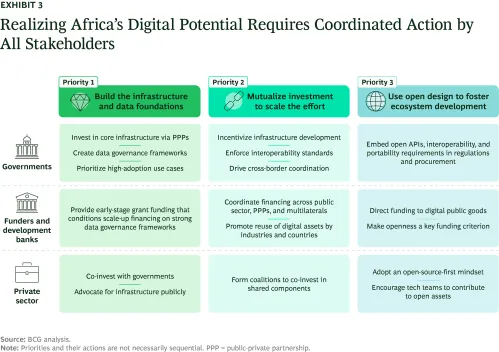
Morocco's National Population Register offers another example of a successful open-source approach. The register was built on MOSIP, an open digital identity platform originally developed in India. By leveraging a shared digital public good, Morocco built a system tailored to its particular needs. The register has improved the way the country targets public programs, and it has engaged local talent to develop and operate the platform, thus anchoring value and capabilities domestically. (See Exhibit 3.)
Advancing the Agenda
Building on open, modular platforms offers many benefits. It reduces cost by enabling countries to leverage existing solutions. It strengthens local autonomy, expands local participation, and helps cultivate technical capabilities, while also driving competition and innovation.
Three moves can advance ecosystem development dramatically:
- Embed openness by design. Through regulation, technical standards, and procurement rules that require open APIs, interoperability, and portability, governments can firmly establish openness. Any qualified player can build on top of existing infrastructure.
- Make openness a key criterion for funding. Funders and development banks can stipulate that resources be directed to reusable, nonproprietary digital public goods.
- Secure an operator. Open-code systems don’t run on their own. The operator may be commercial, as long as the underlying protocol layer remains open and portable.
Embedding Trust and Security Across the Board
Governance is vital for creating a thriving digital ecosystem. Governance encompasses data, players, and the system itself, and cuts across all three priority areas. Similarly, trust and security cut across all areas.
Lack of trust is a prominent barrier to adoption. When citizens have no legal recourse and no control over their data, they resist participating in the system. As a result, the system fails to scale, regardless of its technical quality. According to a recent whitepaper, citizens have no legal recourse mechanism in 94% of emerging economies, and 18 countries already operate identity systems that lack an adequate legal framework, creating a structural risk to sustainability.
As systems become more open and interconnected, trust becomes increasingly critical. This requires embedding basic security, clear accountability, and transparent operating rules from the outset to ensure that systems remain reliable without slowing innovation or hindering ecosystem participation.
Shaping Africa's Next Growth Chapter
Africa's digital future will be defined not by how much technology it adopts, but by where it creates value, where it develops capabilities, and where jobs emerge. African institutions must shape how players build, deploy, and govern systems, anchoring data, infrastructure, and innovation locally.
Public- and private-sector leaders need to have a shared understanding of what is at stake. They also need practical tools and strategies for structuring partnerships, pooling investments, and fostering open systems that will create trusted, interoperable systems that scale across institutions and borders. Organizations such as the African Union and the African Development Bank and platforms such as the Africa CEO Forum have key roles to play.
But beyond infrastructure and architecture and beyond standards, data governance frameworks, and investment pipelines, two pivotal questions remain. Do the public agencies responsible for deployment and stewardship possess the leadership and the skills necessary to manage these responsibilities effectively? And is the operating environment amenable? The reason a digital transformation effort fails is almost never technical. Success hinges on organizational alignment, Incentives, and accountability.
Africa has the ambition and, crucially, the talent it needs. With focus, coordination, and political will, the continent can transition from disadvantaged digital consumer to empowered digital value creator and can secure its economic future.
The authors thank Jeune Afrique Media Group for coordinating the Africa CEO Forum Annual Summit, held May 14-15, 2026, in Kigali, Rwanda. They also express their appreciation to the following organizations for their contributions to this publication: UM6P, Africa Re, Aig-Imoukhuede Foundation, IremboGov, IN Groupe, UNDP/Better Than Cash Alliance, Arise Foundation, and BOAD.


