
Economic Parity Prolonged in Africa
The COVID-19 pandemic dealt a heavy blow to women’s economic participation globally, but its impact was disproportionately felt in Africa. In the World Economic Forum’s Gender Parity
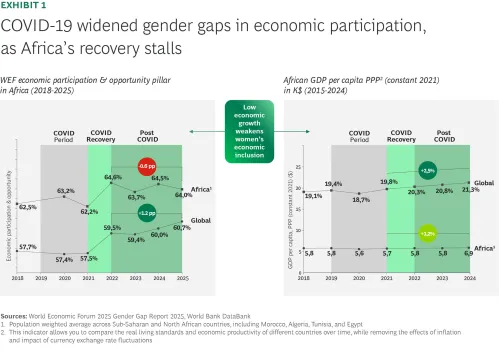
What WEF Gender Parity Index measures: The WEF Gender Parity Index measures gender equality regardless of a country’s development level, with one of its key pillars being ‘Economic Participation and Opportunity'. A score of 1 or 100% signifies full parity while a score of 0 or 0% indicates total gender inequality.
After a brief post-COVID recovery, momentum quickly faded. Between 2022 and 2025, women’s economic participation in Africa declined again by 0.6 percentage points. This extended their path to economic parity from 120 years to about 170 years, adding an extra 50 years (almost two generations), while the gap reduced globally. Africa’s post-COVID journey has been slower, more uneven, and far less inclusive, leaving women behind even as the world moves forward.
This regression is rooted in deeper structural vulnerabilities. During economic downturns, women, who make up about 71% of Africa’s informal workforce compared with 59% of men, are typically the first to lose work and the last to regain it. Between 2021 and 2024, Africa’s GDP per capita grew annually by only 1.2%(in purchasing power parity, constant 2021 dollars), far below the global average of 2.5%, limiting the creation of stable, formal jobs. Since so many women are in precarious employment, the post-pandemic rebound has not translated into durable economic inclusion.
These numbers only tell half the story. Beneath these figures lie deeper systemic challenges: Societal attitudes toward women’s roles have deteriorated further over the past two years (See Exhibit 2.).
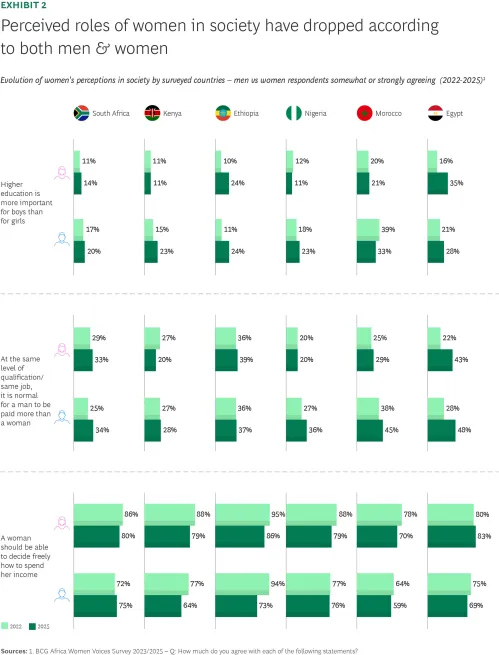
In 2025, fewer respondents supported women’s autonomy, equal pay, and access to education. Worryingly, this decline is not limited to male perceptions. Even women are now less likely to endorse these principles, signalling internalised discrimination. This regression in perceptions mirrors and explains part of the fall in women’s economic participation. When social norms regress, so does economic empowerment. The perceived reasons behind women’s challenges remain the same, but their intensity has worsened across the board. In 2025, a higher percentage of women said that access to economic opportunities, gender-based violence, safety in public spaces and house responsibilities were their top concerns (See Exhibit 3.).
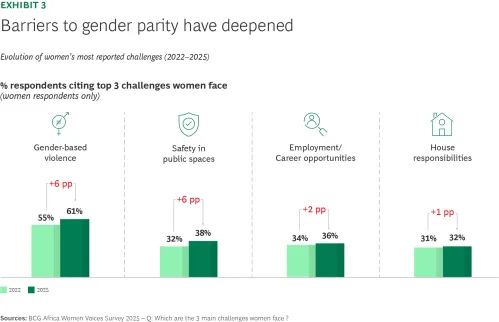
- Safety and violence: Concerns about personal-safety and gender-based violence remained among the top challenges cited by women in our survey.61% identified gender-based violence as their number one concern, followed by 38% who cited security in public spaces.
- Employment & career opportunities: Women’s access to formal employment remains limited. Two-thirds were working in the informal sector, and labour force participation was 12 percentage points below men's in Sub-Saharan Africa in 2024.
- House responsibilities: Increasing numbers of women are out of the labour force due to heavy care burdens and their overwhelming share of unpaid domestic work. The result is reduced participation, fewer full-time hours, and slower wage progression.
As the formal economy continues to exclude and under-serve women, many are clinging to entrepreneurship as one of the few viable paths to economic security and self-determination.
Digital Entrepreneurship Offers a Lifeline:
Sub-Saharan Africa now boasts some of the world’s highest female entrepreneurship rates. Approximately 26% of adult women are engaged in entrepreneurial activity, according to a Harvard study. Across countries surveyed, 93% of women respondents said they wanted to participate in the economy, with 66% aspiring to run their own business, a number reaching over 80% in Nigeria and Kenya (See Exhibit 4.).
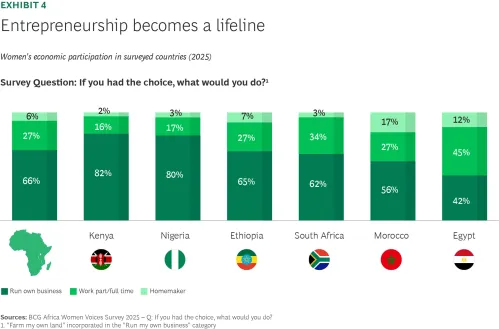
For men, starting a business is often about a means to scale, compete, and build wealth. In contrast, women often engage in necessity-driven entrepreneurship, starting businesses to sustain themselves rather than seek venture-backed or high-valuation growth.
For many, it becomes a path to agency and independence, leading them to build ventures rooted in lived experience and focused on community needs, such as healthcare, retail, education and agriculture (See Exhibit 5.).
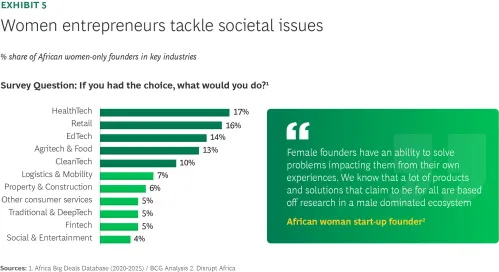
This entrepreneurial momentum is increasingly supported by women’s digitalisation adoption. Technology is broadening access, visibility, and opportunity, enabling women to expand businesses that previously operated on a smaller scale.
According to the BCG survey, one in five African women surveyed already runs an online business, and two-thirds are considering starting one (See Exhibit 6.). They outpace men in digital business ambition.
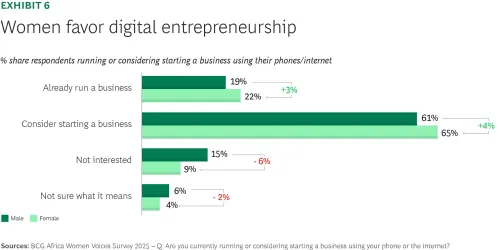
Digitalisation is helping women to alleviate the structural barriers that have long limited their economic participation:
- Stronger flexibility and safety: 61% of women run their businesses from home, enabling them to balance family care with economic activity and reduce exposure to unsafe travel and workspaces.
- Lower financial barriers to entry: Running a business via smartphone or app slashes costs. SMEs that adopt digital tools see productivity rise by 25% and operating costs fall by ~30%.
- Expanded market access and network reach: Platforms like Facebo ok Marketplace and Jumia reported that 40–50% of their sellers in African countries are women. This is proof that digital ecosystems can unlock scale without physical expansion.
- Extended financial inclusion: Fintech has expanded women’s access to finance. In Uganda, mobile loans have raised women entrepreneurs’ profits by 15% and assets by 11% in just eight months.
Current Funding Gap Stalls Progress
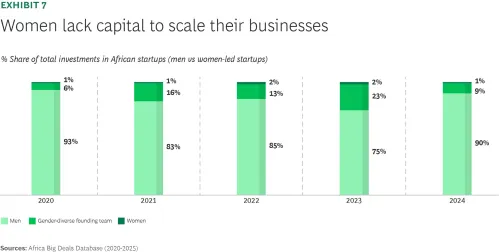
Even in Africa’s rapidly digitising entrepreneurial landscape, longstanding inequalities persist in new forms, constraining women-led businesses from scaling. Women entrepreneurs remain one of the continent’s most underleveraged growth engines. Women-led start-ups attracted less than 1% of total Venture Capital (VC) funding in Africa (2024), despite strong entrepreneurial activity (See Exhibit 7.).
This has resulted in a $2.5 billion funding gap compared to male-founded start-ups in the past five years, a gap that persists despite stronger performance.
Female-founded ventures generate 2x more revenue per dollar invested and achieve 10% higher long-term growth than their male-led counterparts.
This exclusion extends into the digital realm. According to the Cherie Blair Foundation’s 2024 survey, while most women respondents (92%) owned a smartphone, 45% lacked regular internet access, mainly because of cost barriers. Together, these patterns reveal a vicious cycle, in which limited financial means curtail both business growth and digital inclusion.
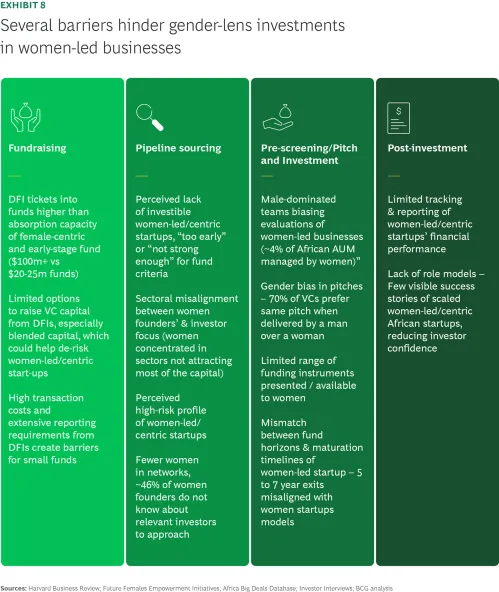
These barriers mirror broader structural and behavioural biases across the investment value chain, not just in access to capital, but how the ecosystem sources, evaluates, and supports digital women-led ventures (See Exhibit 8.).
Alternate Financing to Unlock Women’s Potential
As seen above (See Exhibit 7.), VC funds which represents over 60% of total entrepreneurial funding in Africa fail to deliver equitably to women who found necessity-led businesses. Therefore, women turn increasingly to alternate sources, primarily grants. More than half of women-led businesses in Africa are grant-funded. Grants play a critical role in catalysing early-stage development, but over-reliance on them can inadvertently limit the development of scalable, investment-ready enterprises (for example, by sending signals that start-ups relying on grants are impact-oriented).
To fully realise the potential of women entrepreneurs, the startup funding ecosystem must evolve beyond the conventional VC-driven model toward financing approaches that are more sustainable, adaptable, and growth-oriented. This transformation calls for closer collaboration among investors, Development Finance Institutions (DFIs), and other ecosystem partners to design instruments better aligned with the types of businesses women typically build: enterprises that are community-driven and sustainable rather than focused on rapid, exponential growth.
A few examples of these approaches are:
- Creating smaller, more agile funding mechanisms that align with early-stage venture dynamics, by providing smaller tickets ($50-100,000)
- Designing blended financing instruments (equity, convertible notes, revenue-based or debt options) to better match the capital needs and growth models of women-led businesses.
Beyond capital, it is also vital to offer comprehensive non-financial resources that empower women entrepreneurs. These resources should include access to investor networks, targeted financial education, and strategic collaborations with accelerators and industry experts.
DFIs are driving this progress by shaping financing mechanisms that attract pri vate investment and strengthen women-led ventures by:
- Allocating smaller ticket sizes and channel grants to gender-lens venture capital funds to catalyse women-led investment
- Deploying first-loss or early-stage capital through blended instruments (equity, debt, guarantees) to de-risk investments for investors
Partnering with local financial institutions to offer guarantees and insurance mechanisms that expand debt access for women entrepreneurs.
The case for action is not only based on return on equity, but also on unlocking economic growth. Women entrepreneurs are uniquely positioned to drive innovation in sectors such as health, education, finance, and mobility, areas where they deeply understand the needs of their communities.
About BCG’s Africa Women’s Voices:
This publication is the 2nd edition of Africa Women’s Voices, a report by the BCG Centre for Inclusive Advantage, exploring how African women’s role is evolving. It draws on two key sources:
- BCG’s Africa Women’s Voices Survey 2025, conducted in July 2025. The survey engaged 3,000 women and men across six major African economies (South Africa, Nigeria, Ethiopia, Kenya, Morocco, and Egypt) and included in-depth questions to understand perceptions of women’s role in society, structural barriers they face, and their entrepreneurial drive.
- WEF’s Global Gender Gap Report 2025, which tracks gender parity progress across four dimensions: economic participation and opportunity, educational attainment, political empowerment, and health & survival.
Acknowledgments
The authors would like to particularly thank their BCG colleagues for their valuable contributions to this report. In particular, they thank Thomas Jensen and Soliman Erik Bentaibi and the editorial, PR, marketing, and design teams.


