
This article is a collaboration between BCG and the Terminal Industry Committee 4.0 (TIC4.0).
Ports and terminals are no strangers to reinvention. Over the past 50 years, the industry has managed and adapted to the shift to containerization and ever-larger vessels, the move from paper manifests to electronic messaging and transactions, and the subsequent evolution to system-to-system integration with other parties in the shipping industries. But many port functions still run on clipboards, radio calls, or the gut instincts of a planner, who has watched the yard fill up and empty thousands of times. That is most visible at smaller terminals and in bulk ports.
AI is the next wave, and this time it reaches the clipboard. It arrives as pressure builds from beyond the docks. The freight forwarders, logistics providers, and container liners that are a terminal’s customers are among the companies now investing heavily in AI, with spending across industries expected to increase over time.
To assess how far the industry has come, BCG and TIC4.0 (an international nonprofit association of terminal operators and equipment and solution providers dedicated to the creation and promotion of digital standards for the cargo-handling industry) surveyed more than 100 leaders from across the container ports and terminals ecosystem. (See the sidebar, “Survey Demographics.”) AI is no longer an experiment at the edge of the business. On average, those we surveyed are already using or exploring the top 16 of the 43 use cases we assessed, from extracting data from shipping documents (62%) to predicting when a crane or straddle carrier will fail (48%).
Survey Demographics
Respondents were 103 experts across five continents, drawn from terminal operators, port authorities, container liners, and port vendors. They operate at regional, national, and global scale, and their companies are balanced across small (less than $1 billion in revenue), midsize ($1 billion to $8 billion), and large (more than $8 billion).
The decision to adopt AI has been largely made across the industry. What it is worth has not been settled. The work now is to prove what it delivers, and to do it faster than the competition. Five findings from our survey show where the industry stands:
- Adoption is broad, but proof is rare. Respondents are finding and testing use cases far faster than they are measuring what those use cases return, and only 4% can show a gain in earnings.
- Unclear return on investment is the main barrier to accelerating implementation, and the doubt runs deeper the further you get from the C-suite. Other significant barriers are concerns about data quality and talent.
- The demand comes from commercial customers, but the gains stay operational. Customers are asking for AI-enabled services, while respondents report keeping nearly all of the benefits inside their own operations.
- The expected payoff is shifting from building AI to using it. Respondents expect the next three years of benefit to come from forecasting, dispatch, and workflow integration rather than from platforms and governance.
- Investment is going into people and existing systems. That includes hiring and training AI talent, reskilling the current workforce, and adding AI to what is already installed.
Together, those findings point to four moves: prove value before you scale, fix the foundations enterprise-wide, shift spending from setup to operations, and codevelop the commercial upside.
Adoption Is Broad, but Proof Is Rare
Nearly half (44%) of respondents have moved beyond early testing into scaling or a later stage, and size helps. Among the largest companies in the sample, those with more than $8 billion in revenue, 56% reported scaling or beyond, versus 32% of those below $1 billion. (See Exhibit 1.)
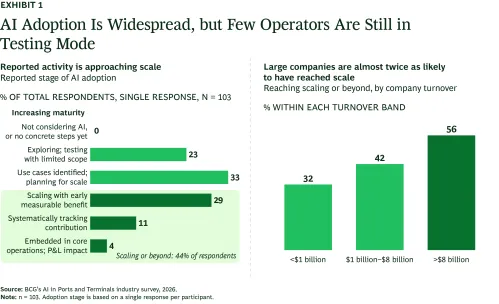
Activity, however, does not always create value. Only 11% of respondents track what AI contributes to efficiency or margin in any systematic way, and just 4% have embedded it in core operations and can point to a measurable gain in earnings. AI is at work inside the gate, in the yard, and in the back office, but almost nowhere is its contribution being measured.
Unclear ROI Is the Main Challenge, and the Doubt Grows Beyond the C-Suite
Unclear return on investment is the barrier named most often, cited by 41% of respondents. It sits well ahead of data quality at 32%, systems integration at 30%, and both executional certainty and implementation cost at 28% each. In short, what holds AI back is doubt about whether it will pay off.
That doubt is not spread evenly and depends on where you sit. Only 21% of C-suite respondents named unclear ROI as a barrier, but below the C-suite, the figure jumped to 44%. The same divide shows up on cost, where just 14% of senior leaders pointed to implementation cost, versus 30% of everyone else. (See Exhibit 2.) C-suite enthusiasm has to be matched by a pragmatic implementation plan at the business-unit level, with full cost transparency for the managers who will be asked to deliver the result.
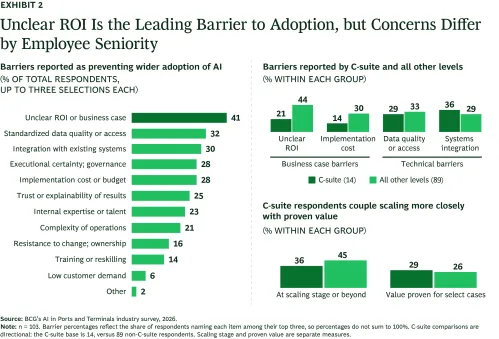
This differentiated point of view on AI feasibility matters, as budgets are approved at the top, pilots are run below, and pilots scale only where the two agree. When the manager closest to the work still doubts the payoff, the test stalls. Yet C-suite respondents describe proven value at much the same rate as everyone else, 29% versus 26%. The open question is what counts as a credible business case.
Standardized data quality is the second-most-cited barrier; roughly a third of respondents pointed to data quality and access as constraints. This comes as no surprise given that AI can only be as good as the information it runs on. The constraint is not only technical. Without shared definitions and semantics, AI can treat two measures that look comparable as if they mean the same thing when they do not and draw misleading conclusions from them. Today, much of that information still sits in fragmented, disconnected systems.
Our 2025 digital benchmark with TIC4.0 saw the same problem from another angle. Most digital roadmaps are still drawn terminal by terminal, with no widely adopted standards, even inside the global and multinational groups that operate many terminals. The same benchmark found cybersecurity concerns slowing the adoption of advanced planning tools that reach across organizations, berth planning among them. In critical infrastructure, security and safety are part of the foundation rather than additions to it.
Talent is another barrier. Roughly a quarter of respondents cited limited in-house expertise, with smaller shares naming resistance to change and a lack of training. The people who can run AI well remain thin on the ground. Neither barrier is a reason to wait. Both are reasons to build the foundation first, in the data that AI runs on and in the know-how of the people who will manage it.
The Demand Is Commercial, but the Gains Stay Operational
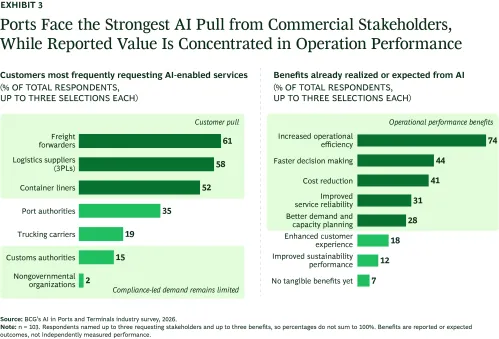
The pull comes from customers, not regulators. Asked which customers and partners are requesting AI-enabled services, respondents named freight forwarders most often (61%), followed by third-party logistics providers (58%) and container liners (52%), which likely reflects what their own customers, the cargo owners, expect of them. That tracks with the wider shift across logistics, where customers now pull adoption more than companies push it from inside. As forwarders and liners build AI into their own operations, they expect the terminal to keep pace.
Respondents’ own reasons for adopting AI point the same way. Asked what motivated them, 69% named cost reduction and efficiency and 47% cited competitive pressure. Regulatory orders came last, at 1%. Port authorities do figure as a source of demand, named by 35%, but this shift is led by the market, not by compliance.
Yet the value that respondents report is almost entirely operational. Operational efficiency leads the benefits realized or expected, at 74%, with faster decision making at 44% and cost reduction at 41%.
A better customer experience reaches only 18%. (See Exhibit 3.) Customers are the stakeholders that are pulling hardest for AI, and the one benefit that would serve them directly is the one that is least reported. That 18% is open ground. Those that turn commercial demand into commercial value will pull ahead of those that keep every gain inside the fence.
The Payoff Is Shifting from Building AI to Using It
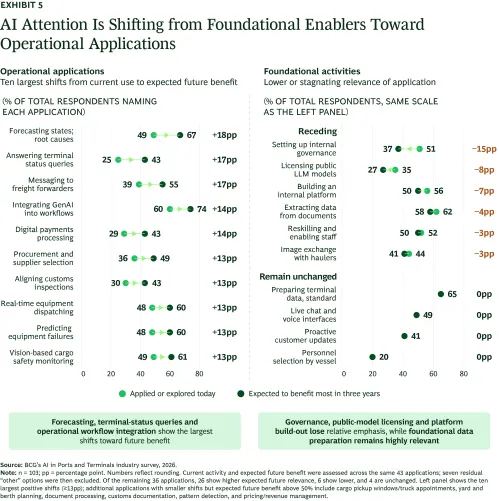
Asked where they expect AI to deliver the most benefit over the next three years, respondents pointed away from setting up AI and toward using it every day. Seven of the 43 use cases were residual “other” options and were excluded from this comparison. Of the remaining 36, respondents named 26 more often as areas of expected future benefit than as areas in use today, 4 were unchanged, and 6 were expected to decrease in relevance. (See Exhibit 4.) The biggest gains foreseen are in running the terminal.
Forecasting operational states and their root causes rises from 49% today to 67% in expected benefit, and integrating AI into daily workflows climbs from 60% to 74%, the most-named use case for future value. Real-time equipment dispatch, predictive maintenance, and vision-based cargo safety monitoring advance alongside them. So do the two use cases that face the customer most directly: answering terminal status queries rises from 25% to 43%, and messaging freight forwarders from 39% to 55%. The industry may not yet be capturing the commercial upside, but it can see where the future lies.
Our digital benchmark traced the same progression in the yard, where rule-based systems are giving way to predictive tools. Dwell-time forecasting estimates how long each container will sit before it moves, and smart stacking uses that estimate to decide where to place it, so the boxes leaving soonest are not under the ones staying longest. AI is carrying that progression into every corner of the operation.
What recedes is the behind-the-scenes work. Internal governance falls from 51% to 37%, and internal platform building from 56% to 50%. Both still matter, but leaders increasingly treat them as groundwork. The window for winning on platform building alone is closing, and the advantage is shifting to operators that can embed AI in the workflows that move cargo.
The Money Is Going into People and Existing Systems
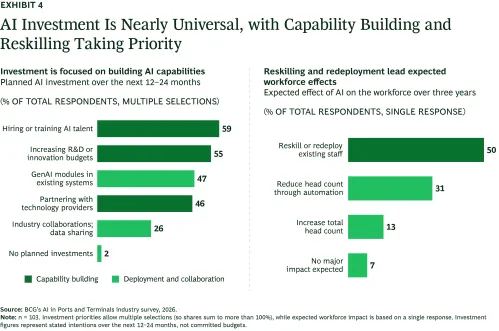
Investment is close to universal. Among the respondents to our survey, investment is close to universal with only 2% of respondents reporting no planned AI spending, though the sample leans toward large and global players, so investment is less likely universal across the industry as a whole. Hiring and training AI talent leads at 59%, followed by R&D budgets at 55% and adding AI modules to existing systems at 47%. (See Exhibit 5.)
The pattern is telling. Respondents are buying capability and building on what they already own, rather than replacing it.
The workforce question runs deeper than any budget line. Half of respondents expect AI to reshape roles through reskilling or redeployment, 13% expect new roles requiring new skills, and 31% expect lower workforce demand as AI automates processes and decisions.
Here, too, the view depends on seniority. Just 14% of C-suite respondents expect head count reduction, against 34% of respondents at other levels. That gap is a reason for leaders to say plainly what they intend.
The automation in that 31% is AI automating processes and decisions, not the machines that move cargo. Equipment automation is a separate question. It replaces physical work at the ship’s side and in the yard, and our benchmark ranked it last among the digital capabilities it assessed, held back as much by labor agreements and community resistance as by capital cost. Those that lead the workforce shift with their people will move faster than those that manage it as a message.
Four Moves Leaders Can Make
BCG’s work on AI estimates that 10% of the value creation comes from algorithms, 20% from technology and data, and 70% from having the right training and processes in place. What this survey describes sits mostly in that 70%. These findings point to four moves, in two stages. The first stage answers the doubt about return and the gaps in data and skills, and it asks leaders to prove value before they scale and to fix the foundations enterprise-wide rather than terminal by terminal. The second stage follows the payoff to where operators and their customers can see it, shifting spending from setup to operations, and codeveloping the commercial upside with the customers already asking for it. The order matters, because an operator that cannot prove a use case pays, or cannot get at clean data, will not get far with the second stage.
Prove value before you scale. With unclear returns the most-cited challenge, leaders should agree up front, for every pilot, on the baseline they are measuring against, the improvement they expect, the timeline they expect it in, and, above all, the single person who owns the outcome.
They should agree, too, on what proven return will look like before the business case moves upward, since much of the gap between the C-suite and the frontline is a difference in definitions. Stage the rollout, with a go or no-go decision at each step, test the riskiest element first, and scale only once the value is shown. Evidence is what wins over a skeptical manager.
Fix the foundations enterprise-wide. Data quality is the next barrier, so leaders should treat data as shared infrastructure rather than a series of local patches. Investing across the enterprise in data quality, access, and integration will unlock more value than any single use case, because piecemeal fixes tend to move the bottleneck rather than remove it.
A port is a network of various stakeholders, such as authorities, terminals, liners, truckers, and depots, and data that stops at the terminal gate stops creating value there too. Common industry data standards are how systems learn to talk to one another. A quarter of respondents already plan to join industry collaborations or data-sharing initiatives over the next two years, and the shared semantics and data models that TIC4.0 is developing and promoting give that intent somewhere to land.
Shift spending from setup to operations. Operators already expect the next three years of benefit to come from running the terminal. Put resources behind operational forecasting, workflow integration, and real-time dispatch, the areas with the clearest growth in expected benefit. Then back them with people. Say plainly what AI will mean for roles and fund the reskilling before the redeployment.
Codevelop the commercial upside. The 18% customer experience figure is an invitation. Work directly with the forwarders, logistics providers, and liners that are already asking for AI and build the services they want, such as cargo visibility, proactive updates, faster documentation, and more reliable service.
The industry has done this before. Since the mid-2000s, ports started to use vehicle-booking systems, sharply cutting truck turn times, and carriers proved willing to pay a booking fee for a guaranteed slot. Singapore has since applied the same idea on the water, with vessel slot booking. Ports such as Antwerp built data exchanges that they and their partners could turn into services. AI widens what can be offered and shortens the time it takes to offer it.
The Next 12 Months
Forty-four percent of respondents are at least scaling AI. Four percent can show what it delivers to earnings. Winners of the next phase will be those that can name a short list of use cases, built into core operations and measured against clear outcomes. That is a more modest ambition than the current wave of experimentation might suggest—and a far more valuable one, because connected value compounds while isolated value merely accumulates.
For terminal leaders, those four moves reduce to three priorities:
- Prove each use case on that short list against a baseline the operations manager closest to the work accepts.
- At the same time, fund the data foundation as an enterprise-wide asset rather than a terminal-by-terminal project.
- Once those two priorities have been addressed, move spending into operational AI and take what it enables to the customers already asking for it.
In ports, technology has always served the business rather than set its direction, and the questions AI now raises about work and the workforce are not ones a technology function can answer. The hard part is discipline, in proving value, building the foundation, and choosing where to focus. That discipline belongs to the leadership team.
The authors thank Gaurav Kumar for his support in creating the survey and analyzing the results as well as Katherina Kyratsas for her valuable review of this article.


