
Saudi consumer sentiment stands in sharp contrast to the caution seen across much of Europe. While European consumers are cutting back and trading down, Saudi consumers feel positive about the economy, their society, and their own lives. They expect to spend more in the coming months, not less. That optimism holds even amid prolonged conflict in the region.
This is the central finding of BCG’s 2026 Consumer Sentiment Survey in Saudi Arabia, which polled 1,895 consumers across 11 product categories. The research for this report was conducted in April 2026, following the military escalation seen in the region. As the situation has continued to evolve since then, the findings should be viewed as a snapshot of Saudi consumer sentiment at the time of the research, while still providing valuable insight into the broader trends shaping consumer behaviour in the Kingdom.
Three messages stand out:
First, optimism is the baseline, but it coexists with pressure on household finances.
Second, confidence comes with discipline. Saving is the first call on extra income, while value for money and convenience drive purchases.
Third, stated preferences do not always translate into purchases. Consumers prefer local brands, yet local origin ranks last among purchase criteria. They consider sustainability, but few will pay a premium, and they discover far more products online than they buy there.
These gaps between sentiment and behavior create opportunities for brands. They also require a note of caution. The survey measures what consumers say they feel and intend to do, rather than observed purchasing behavior. The direction of travel is clear and consistent, but actual behavior may prove more moderate than stated intentions.
Optimistic, despite the squeeze
Ask Saudi consumers how they feel, and the answer is overwhelmingly positive. Across the eight dimensions tested, economic situation, cultural & social atmosphere, physical health, political atmosphere, security of personal data, mental health, personal financial stability, climate & environment, an average of 79% say they feel good, compared with 35% across the European markets surveyed. Even Denmark, statistically the most upbeat European market according to this research, stands at just 43%.
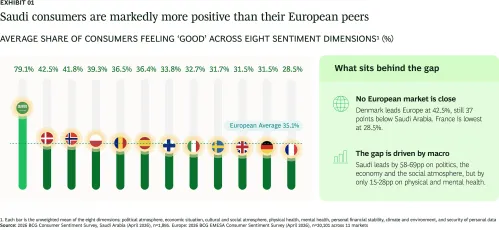
Yet the weakest of those eight measures is the one closest to home. Personal financial stability trails confidence in the economy, while rising prices are putting pressure on household budgets.
Inflation and energy prices are the leading concerns. But rather than prompting consumers to pull back, consumers expect to absorb the rises and continue to spend at higher levels.
Saudi consumers remain confident even though the financial pressure is real.
Confident, but saving first
Looking forward, consumers expect income, savings and spending to rise over the next six months. Expected prices rise fastest. Much of the anticipated increase in spending therefore reflects higher prices rather than greater volumes.
Nor does greater confidence mean indiscriminate spending. Given extra income, consumers would put savings first, ahead of every category of spending. 66% of respondents also say they would sacrifice spending today to save more for tomorrow.
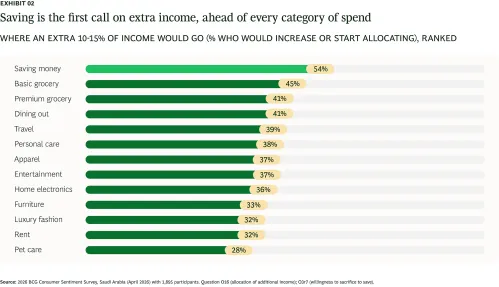
Saving comes first, and consumers still spend selectively on better food, eating out and travel. The pattern is one of financial discipline alongside selective enjoyment.
Spending intentions reinforce that picture. Expected gains are strongest around the home and everyday essentials, while several more discretionary categories lag.
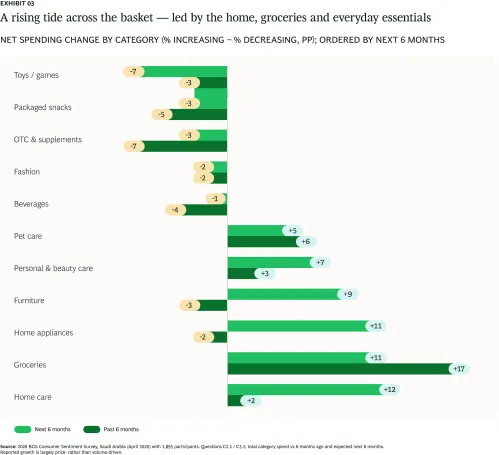
Health may also be shaping consumer choices. It ranks highest among the values tested, with 79% calling it extremely important. Lower spending intentions for packaged snacks and beverages are consistent with that emphasis, while self-reported use of GLP-1 weight-loss medications is highest among millennials. These findings are consistent with health influencing the basket, but the survey does not establish causality. For food and beverage companies, the implication goes beyond marketing. Protein, satiety, portion size and sugar reduction are becoming mainstream product considerations rather than specialist wellness propositions.
Value wins the basket
Purchase decisions follow a practical hierarchy, led by value for money, functionality and price. Trusted brands rank further down, while local production comes last.
Brand choice is also fluid. Only 31% of purchases involve a brand chosen in advance, leaving around seven in ten potentially open to influence at or near the point of purchase.
Discounts matter, but value is not simply about paying less. 59% of consumers are also willing to pay more when better quality justifies it.
Local brands illustrate the distinction particularly well. Two-thirds of consumers say they seek them out, yet local production ranks last among the factors that actually decide a purchase. Preference, in other words, does not necessarily translate into choice. Local origin can strengthen a proposition, but only when accompanied by the value, quality, and availability consumers expect.
The same conditional attitude applies to personal data. While 61% do not want brands accessing their data, 46% accept its use in return for personalization. Consumers are open to personalization, but on clear terms. They need to understand what data is being used, what they receive in return, and how it is protected.
Sustainability without the premium
Sustainability reveals an even wider gap between preference and purchase. Most consumers consider it when buying, yet 86% expect a sustainable option to cost the same as or less than the conventional alternative. Only 14% are willing to pay any premium.
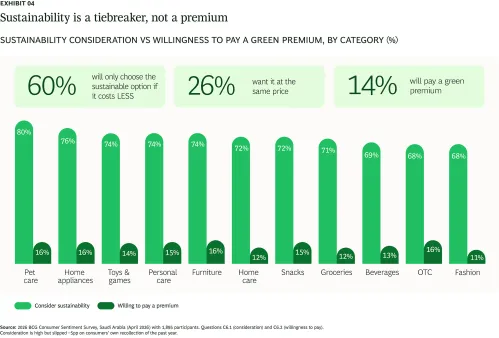
For brands, sustainability therefore works best when embedded in the proposition rather than sold as an expensive extra. The commercial case becomes stronger when environmental benefits accompany something consumers value directly, such as better health, durability, or reduced waste.
Discover online, buy in store
Saudi consumers are firmly digital when discovering and researching products, but purchasing remains much more physical. Across categories, online discovery consistently outpaces online purchasing, while 85% of consumers describe a physical store as important or essential to their decision.
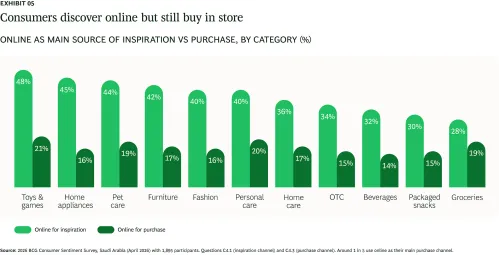
Market data adds another perspective, although the measures are not directly equivalent. The survey captures consumers’ main online purchase channel, while Euromonitor measures e-commerce as a share of category retail value. Even with that caveat, the comparison suggests that digital conversion varies sharply by category. E-commerce penetration is relatively high in OTC, fashion and home care, but much lower in groceries, snacks and beverages.
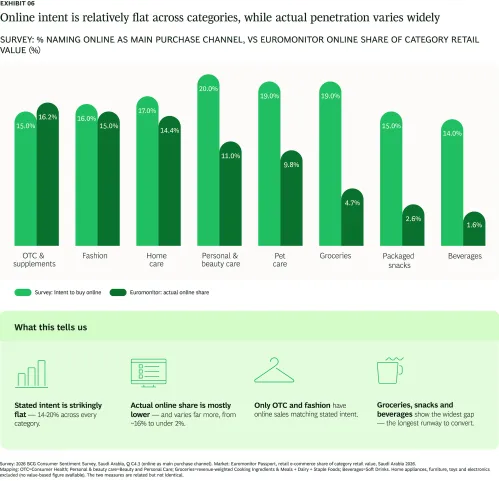
The opportunity is to connect the two more effectively, not simply to push consumers from stores to e-commerce. Brands need to win discovery online while making it easy for consumers to complete the journey wherever they choose.
AI-generated recommendations are becoming part of that discovery layer, although the survey suggests receptiveness rather than enthusiasm. 72% of consumers have at least ‘moderate’ trust in AI, and it sits almost exactly at the midpoint of the 1-5 scale at 3.05, with almost no variation between generations of consumers.
For brands, this is an emerging channel rather than an established one. Brands will need to make product information accurate, structured and AI-readable, alongside search and social discovery.
The luxury market echoes the pattern
Disciplined confidence extends up the market too. BCG's 2026 True-Luxury research points to strong underlying demand and substantial growth potential for Saudi luxury.
Among consumers buying second-hand durable goods, access to premium brands for less is a stronger motivation than sustainability.
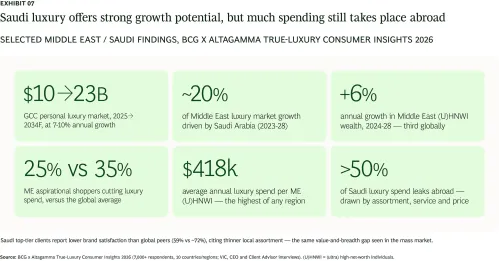
Yet much of that demand is still being captured elsewhere. Saudi consumers continue to make a substantial share of their luxury purchases abroad, attracted by greater choice, service and price, while top-tier Saudi clients report lower brand satisfaction than their global peers.
The mass market tells the same story. Consumers are willing to spend, but brands still have to earn the purchase through value, quality, availability, and choice.
What this means for brands
Saudi consumers expect to spend more while staying highly selective about where that money goes, a combination that is increasingly rare. The opportunity is growth, but not growth at any price.
Priorities follow from the findings:
- Ride the tide: Prioritize categories with the strongest spending intentions, particularly the home, groceries, and everyday essentials.
- Engineer value with quality: Avoid a race to the bottom and combine competitive pricing with quality that gives consumers a reason to trade up.
- Win the moment of decision: Use promotions, availability, in-store visibility, and clear value cues that convert consumers while brand choice is still open.
- Build health in by default: Make health part of the mainstream food and beverage proposition, not a specialist sub-range.
- Embed sustainability at parity: Make sustainability part of the proposition without relying on a green premium and link it to tangible consumer benefits.
- Connect digital discovery with physical purchase: Invest in search, social, marketplaces, and AI-ready product information, while making the path to checkout, click-and-collect, or an in-store purchase frictionless. Use personalization where the value exchange around data is clear.
- Reward financial discipline: Use cashback, bundles, loyalty benefits, and installment options to appeal to consumers who want to spend while preserving financial discipline.
- Keep demand at home: Strengthen assortment, availability, service, and pricing to capture more premium spending domestically.
The defining characteristic of the Saudi consumer in 2026 is disciplined confidence, not confidence alone. Consumers are optimistic, willing to spend, and open to new brands, but they expect every purchase to justify itself. The companies best placed to grow will be those that make that choice easy.
Methodology
In April 2026, BCG surveyed 1,895 consumers in Saudi Arabia on their current concerns, personal finances and shopping behavior across 11 consumer categories. European comparisons draw on BCG’s parallel 2026 EMESA Consumer Sentiment Survey of around 20,000 consumers across 11 markets using the same questionnaire.
Luxury findings draw on the 2026 BCG x Altagamma True-Luxury Consumer Insights study. Category-level online sales figures are from Euromonitor Passport for Saudi Arabia in 2025. Survey measures of consumers’ main online purchase channel and Euromonitor measures of e-commerce share of category retail value are related but not identical. Net spending is the percentage of consumers reporting an increase minus the percentage reporting a decrease. Reported spending growth is, in most categories, driven more by higher prices than higher volumes.


