
Back-to-School is an annual reset for Canadian families. Kids get new routines, first-day outfits, and a backpack full of fresh supplies. Parents get the bill. For retailers, it is one of the year’s most important moments to re-engage a key customer segment and make the occasion a little less stressful.
This year, the same cart costs more. Nearly 60% of Canadian parents expect to spend more than last year, with the average family budgeting close to $700 for the season, adding pressure to already-stretched household budgets.
BCG surveyed over 1,200 Canadian parents to find out what is happening beneath the surface. The findings point to two truths and a myth about back-to-school shopping.
Truth: Back-to-School Spend Is Breaking Canadian Household Budgets
More than half of Canadian parents say back-to-school shopping does not fit within their normal household budget. Rising prices are the main driver, not bigger baskets or deliberate trade-ups, with over 50% of parents citing price increases as the reason they are spending more this season, consistent across all categories. (See Exhibit 1.)
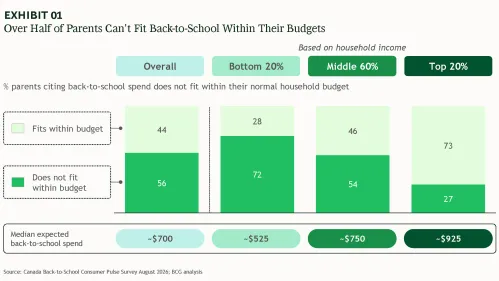
The average family is budgeting close to $700 for the season, but that masks a clear income divide. Bottom-20% households plan to spend about $525 this season, while Top-20% plan to spend about $925, nearly twice as much. It is not just the Bottom-20% feeling the pinch. Middle-60% families are twice as likely as Top-20% to say back-to-school spending does not fit their normal budget.
The income divide is more complicated than value-seeking consumers at one end and affluent consumers at the other. Lower-income families are planning to spend materially less and are still struggling to absorb the bill. For many parents, protecting the school list means spending less elsewhere with dining out, entertainment, and non-school clothing reported as the first categories to be cut.
The pattern matches what BCG has been tracking across Canadian consumer spending more broadly, with the Top-20% pulling away while everyone else leans increasingly on savings and debt. Back-to-School brings that pressure into focus, as many families stretch beyond their normal budgets to fund a season that is difficult to skip.
Truth: AI Is Now a Mainstream Shopping Tool, and Those Who Use It Shop Differently
Nearly half of Canadian parents plan to use AI tools for back-to-school shopping this year, most often to find deals, get recommendations on what to buy, and plan the budget. More telling is how those shoppers behave.
AI users have bigger budgets. They skew higher income, with Top-20% households twice as likely to use AI and spending $300 more than non-users this season. AI users also arrive early. By early August, 88% of AI users had already begun shopping, compared with 65% of non-users. And many start digitally. Over 60% begin their shopping journey using digital channels such as AI tools, search engines, social media, or retailer sites, more than twice the share of non-users. (See Exhibit 2.)
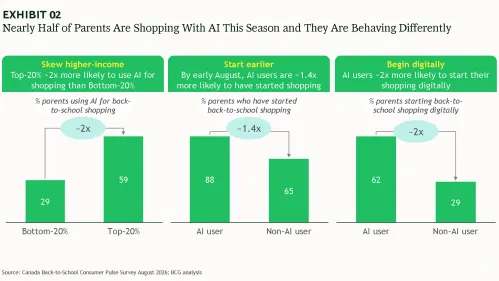
It is clear some of retail's highest-spending customers are already bringing AI into an ordinary shopping occasion and they are giving it meaningful work. Although AI users still complete at least half of their back-to-school purchases in-store, AI is becoming an increasingly important first step to shape the basket before parents set foot in a store. Retailers who are not already investing in generative engine optimization (GEO) to show up in AI-generated recommendations are falling behind for the seasons to come.
Myth: Tech Has Taken Over the Back-to-School Basket
Even as technology becomes more essential in day-to-day life, the back-to-school basket remains remarkably traditional. Clothing and shoes are considered a must-buy by 82% of parents, stationery by 76%, and bags and gear by 72%. Tech hardware comes in at just 29% and tech accessories at 23%. For retailers, a more digital world does not mean a digital basket. (See Exhibit 3.)

The most common reason parents give for sitting out on tech purchases is that their child already has a suitable device. Unlike clothing or stationery, tech does not follow an annual replacement cycle, with devices lasting several years. This leaves only a subset of families in the upgrade window in any given season.
Yet there is a small segment, roughly one in five parents say tech is unnecessary for school, and that view is twice as prevalent among Bottom-20% households as it is among Top-20%.
The families who need a new device this year will buy one somewhere, at some point, but are weighing back-to-school against Black Friday and Boxing Day too. Retailers who make the most compelling case for buying now will capture the sale before a competitor does.
Back-to-School is a Dry Run for the Occasions to Come
The back-to-school shopping season opens a string of high-stakes spending occasions, with Thanksgiving, Black Friday, Christmas, and Boxing Day following in quick succession. The habits and trade-offs parents are revealing right now are the clearest signal retailers will get before the holiday season begins. The retailers who act now, building the right value-focused proposition, establishing an effective AI presence, and converting big-ticket shoppers, will be the ones to win the seasons ahead.


