
AI is now a proven economic force. Enterprise investment in AI doubled in 2026 from the previous year and that growth touches every industry. The investment is also starting to pay off. In a recent BCG survey, nearly nine in ten CEOs reported cost or revenue benefits resulting from their AI investment. This is an early indicator of the shift in AI from potential to actual value creation.
The question now facing economies around the world is: Who is positioned to capture its value? The answer depends on four factors:
- AI’s disruption potential for a country’s key economic sectors and existing labor market.
- How quickly an economy can convert AI capability into deployed value.
- A country’s strategic options given the current makeup of its economy.
- An economy’s ability to adapt to broad economic, social, and environmental changes.
BCG’s 2026 AI Maturity Matrix assesses more than 75 economies on two key dimensions––an economy’s AI exposure and AI readiness––across 33 indicators, with three new indicators on compute, domestic model development, and regulation added to our analysis this year. We supplement those findings with strategic analysis of steps governments have taken—and can take—to improve their readiness, based on their exposure.

An economy’s AI exposure is largely determined by the potential for automation and reinvention of its key sectors and the impact on jobs in those sectors. Today, exposure is concentrated in knowledge work, but that exposure will broaden as physical AI and agentic systems advance. In fact, a shift toward disruption of the physical economy is already underway as embodied AI (physical AI that operates machines, robots, and vehicles) grows in capability and scales.
A shift toward disruption of the physical economy is already underway as embodied AI (physical AI that operates machines, robots, and vehicles) grows in capability and scales.
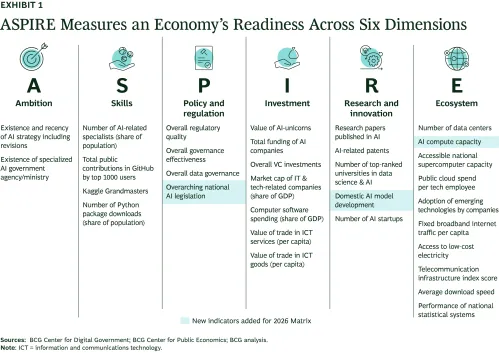
Readiness, the Matrix’s second measure, assesses how prepared an economy is to capture AI opportunities. Readiness is measured across six dimensions using the ASPIRE framework, BCG's flagship national AI preparation assessment. The ASPIRE framework represents a country’s Ambition, Skills, Policy and regulation, Investment, Research and innovation, and Ecosystem. (See Exhibit 1.)
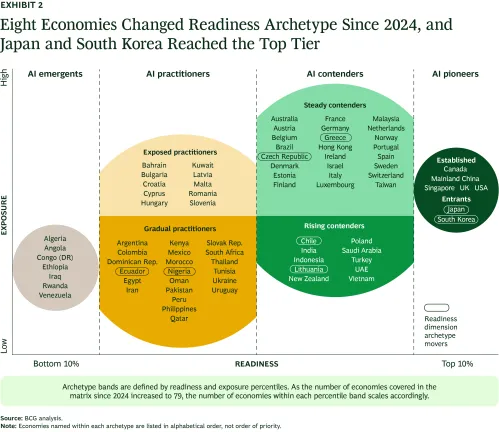
Within the overall matrix, we classified individual economies’ exposure and readiness into one of six archetypes of economies. These are (from highest readiness to lowest, with subgrouping based on exposure): AI Pioneers, Contenders (Steady and Rising), Practitioners (Exposed and Gradual), and AI Emergents. (See Exhibit 2.)
AI Readiness Is Improving Everywhere, but Not at the Same Speed
In the two years since BCG compiled the first AI Maturity Matrix, most economies have made meaningful progress in their AI readiness, leading to higher scores across the study. Nearly every economy progressed in at least one ASPIRE dimension in 2026, and eight moved up to a more advanced readiness archetype: Japan, South Korea, Greece, the Czech Republic, Chile, Lithuania, Ecuador, and Nigeria.
A government’s capacity to facilitate AI development is a key driver of archetype improvement. Among leading economies, Japan and South Korea joined the AI Pioneers as an entrant (alongside established pioneers Canada, Mainland China, Singapore, the United Kingdom, and the United States). Japan leveraged its ability to attract partners and an AI-friendly regulatory framework to build up its ecosystem and secure large hyperscaler commitments. South Korea has shown leadership in domestic model development, while directing large-scale public investment in developing its ecosystem and building up compute.
In the 2026 Matrix, AI ambition is no longer enough to differentiate an economy. Nearly every economy now has a published AI strategy, and what differentiates the economies that made the most progress on the Matrix is the scale and speed at which their capability was built up.
Nearly every economy now has a published AI strategy, and what differentiates the economies that made the most progress on the Matrix is the scale and speed at which their capability was built up.
Exposure: Which Sectors and Jobs Does AI Actually Reach?
This year’s AI Maturity Matrix offers a more sophisticated look at the extent of AI’s reach today. While task-level analysis deepens our understanding of automation potential, exposure and its impact are expected to evolve with AI’s growing capabilities.
Exposure is now measured at the task level. Enterprise data, hiring patterns, and capital flows now show where AI is already reshaping work, while the rise of agentic AI (systems that carry out multistep tasks instead of assisting with just a single task) has widened the scope of jobs that AI can reshape.
Exposure is concentrated in knowledge work today, but physical AI is growing. For now, exposure is greatest where AI is most capable—language and code—but as embodied AI advances and scales across humanoid robotics and industrial automation, more physical industries, like manufacturing, logistics, and agriculture, are expected to increase in exposure.
Business leaders’ workforce strategy choice is between augmentation and substitution—and national policy follows. As businesses in different industries adopt AI and respond to its impact on their sector, they’re choosing between augmentation of their workforce—redesigning roles to enable people to collaborate with AI—and substitution of their workforce, where AI alone performs tasks previously performed by people.
Lower existing AI exposure still leaves room for sector spillover. The strategy is that AI deployed at scale in an anchor industry increases capability in the engineering, logistics, and service suppliers currently built around that anchor sector.
Readiness: How Fast Can an Economy Turn Capability into Value?
In 2026, readiness is almost entirely determined by the speed with which a nation can act on AI exposure. Below we look at all six ASPIRE dimensions and how they affect the readiness of specific countries.
Ambition. Now that nearly every economy assessed has published an AI strategy, what separates leaders is whether they implement that strategy and refine it.
Skills. Winning the top tier of AI-native professionals has become harder. That is because the pool of highly skilled professionals is shrinking: cross-border relocation of AI talent fell 12% in 2025, increasing the competition for an even smaller hiring population. BCG’s Global Talent tracker provides a detailed analysis of AI talent attraction and retention on a global scale.
Winning the top tier of AI-native professionals has become harder. That is because the pool of highly skilled professionals is shrinking: cross-border relocation of AI talent fell 12% in 2025, increasing the competition for an even smaller hiring population.
Policy. Countries now use policy to attract investment as much as to constrain risk. In 2026, we see both minimal-constraint regimes, which compete on innovation-friendliness, and oversight-based regimes, which compete on establishing trust in their AI approach. The distinction between the two approaches is fading, however, as responsible-AI provisions covering transparency, redress, and human oversight in high-stakes use cases become a condition of sustained adoption across the spectrum.
Investment. Economies have pursued three investment models—concentrated sovereign capital, multilateral country partnerships, and hyperscaler partnerships—that determine how much AI capability they are able to control.
Research and Innovation. Outside the AI Pioneer tier, research focus has shifted from producing frontier capability to absorbing and adapting it locally. For those economies, a credible approach can be found among the following options: openly published models, regional research consortia, and sovereign fund partnerships.
Ecosystem. The constraints on where AI capacity gets built are now physical. Power availability, permitting speed, and interconnection ability are what decide placement of AI facilities. In this case, AI infrastructure means chips, compute and cloud, plus the electricity and connectivity that make them usable. The ecosystem is therefore a gauge of institutional agility, not just a measure of installed infrastructure. Partnership selection is part of that equation.
Where to Begin?
Governments can begin their AI journey by determining both the risk of their exposure and their readiness to act compared with peers.
For more on how each country performed in the 2026 AI Maturity Matrix and what steps your country should take, download the full report here.


