
At first glance, CEOs and boards appear to agree on how AI should be governed, implemented, and valued. Look closer, however, and you’ll see critical gaps that could hinder a successful AI transformation.
In this first edition of Split Decisions: The BCG CEOs and Boards Survey, responses from 625 leaders around the world reveal five areas where chief executives and their boards of directors diverge on AI:
- CEOs worry that AI hype may be distorting boardroom judgment.
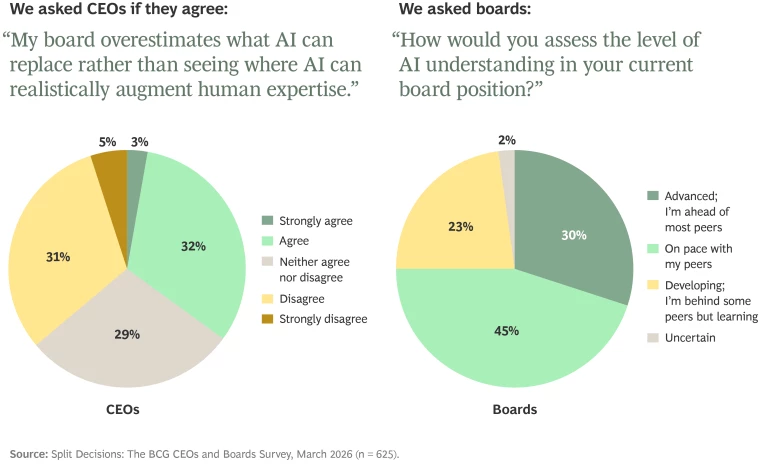
- Boards are confident in their AI understanding, but CEOs are less convinced.
- Boards favor faster AI implementation. CEOs are more measured about the pace of change.
- Both sides agree the executive team should lead on AI, yet CEOs appear to bear an outsize share of the responsibility.
- CEOs see AI ROI as a bigger factor in their performance evaluation than boards do.
At a moment when clear, coordinated leadership is essential, these fault lines could create tension in the boardroom. Explore our findings in greater detail in the following pages.
Methodology
CEOs Say AI Hype Is Distorting Boardroom Judgment
When asked what they wish their boards would do differently regarding AI, more than half of CEOs said boards need to better understand the gap between headline AI hype and reality. Simultaneously, boards felt that CEOs need to do a better job selling them on their AI strategy. In our survey, many write-in comments emphasized the need for more proactive communication regarding CEOs’ vision for AI.

Boards Think They Know AI. CEOs Challenge That Self-Assessment.
While 75% of board members believe their AI knowledge is on par with or more advanced than that of their peers, CEOs have a different perspective. More than one-third of CEOs believe boards overestimate the human capabilities AI can replace, and nearly 40% say boards lack an informed view of how AI is reshaping growth strategy.

Stay ahead with BCG insights on artificial intelligence
Limited AI Understanding Leads to Board FOMO
Approximately 60% of CEOs believe their boards are rushing AI transformation. What’s more, our data suggests that lower levels of self-assessed AI understanding may be fueling board FOMO (fear of missing out). Board members with less confidence in their AI knowledge are more likely to believe their organizations are moving too slowly, indicating that uncertainty is translating into a heightened sense of urgency. At the same time, our research finds that frustration with the pace of adoption is highest in those who have a more permissive view on governance, underscoring a growing tension between the desire for speed and the need for oversight.


AI Should Be Led by the Executive Leadership Team, Boards and CEOs Say. But CEOs Do the Heavy Lifting.
The majority of board members and chief executives agree that AI strategy should belong with the executive leadership team, but in practice CEOs still take the lead. According to 47% of CEOs, they are heading up AI implementation, with 39% of board members reporting the same. What’s more, fewer than 10% of both boards and CEOs believe that AI strategy should be led by a chief AI officer, reinforcing the position that all C-suite roles—such as the chief marketing officer, chief people officer, and chief transformation officer—have a role to play in AI implementation.


CEOs Put More Weight on AI in Their Performance Reviews Than Boards Do
Despite growing pressure to deliver on AI, boards think that only about a quarter of a CEO’s performance review pivots on meeting AI ROI goals. CEOs, however, believe that more than a third of their performance is tied to AI outcomes. This suggests a gap between perceived expectations and formal accountability.


AI Literacy Is Now a Must-Have Skill for Board Membership
Given the apparent disconnect between CEOs and boards on crucial AI issues, it’s no surprise that AI literacy is rapidly becoming a baseline expectation for board membership, not a differentiator. We found that 79% of CEOs and 80% of board members believe that prospective members should be required to demonstrate a measurable understanding of how AI can reshape their industry.


